
Porsche Is Still Luxury’s Most Valuable Brand. So Why Is Volkswagen Taking a €6 Billion Impairment?

Share

Five days apart, Porsche produced two headlines that look almost designed to confuse anyone who does not spend their evenings reading accounting footnotes for fun.
On September 18, Volkswagen said an impairment test would result in an approximately €6 billion non-cash impairment of goodwill allocated to its Porsche business segment. The charge is expected to weigh on Volkswagen Group operating profit in the third quarter.
Then, on September 23, Brand Finance published its Luxury & Premium 50 ranking and named Porsche the world’s most valuable luxury and premium brand for the ninth consecutive year, with an estimated brand value of $35.2 billion.
So how can Porsche still be No. 1 while Volkswagen is taking a multibillion-euro write-down connected to the business?
Because those numbers are not competing valuations of Porsche.
That distinction is the story.
First: These Numbers Are Not Measuring the Same Thing
Brand Finance’s $35.2 billion figure is an estimate of the economic value of the Porsche brand under Brand Finance’s methodology.
Volkswagen’s roughly €6 billion charge is an accounting impairment of goodwill allocated to the Porsche business segment in Volkswagen’s consolidated financial statements.
The cleanest way to see the difference is in Volkswagen’s own 2025 accounts. At the end of 2025, Volkswagen separately carried about €13.8 billion of Porsche brand names and about €16.2 billion of Porsche goodwill on its balance sheet.
Those are already two different accounting assets before Brand Finance enters the picture.
| Number | What it measures | What it does not mean |
|---|---|---|
| $35.2 billion | Brand Finance’s estimated value of the Porsche brand in 2026 | Porsche AG market value, enterprise value or Volkswagen accounting goodwill |
| €13.8 billion | Volkswagen’s 2025 carrying amount for Porsche brand names | Brand Finance’s independent brand valuation |
| €16.2 billion | Volkswagen’s 2025 carrying amount for Porsche goodwill | The market value of Porsche or the Porsche name |
| ~€6 billion | Volkswagen’s expected 2026 non-cash impairment of goodwill allocated to the Porsche business segment | “The Porsche brand is worth €6 billion less” |
The accounting logic is simpler than the terminology makes it sound.
Volkswagen carries goodwill because the Porsche business is expected to generate economic value above the identifiable assets sitting on the balance sheet. If updated forecasts no longer support the amount being carried, some of that goodwill has to be written down. IAS 36 is the accounting standard that governs that impairment test.
So Volkswagen did not announce that the Porsche name itself had suddenly lost €6 billion of value.
It concluded that revised expectations for the Porsche business no longer supported all of the goodwill Volkswagen had been carrying for it.
And this is not the first reset. Volkswagen’s 2025 annual report recorded a €2.7 billion non-cash impairment of goodwill allocated to the Porsche operating segment after Porsche adjusted its business planning and product strategy.
The 2026 charge is therefore not an isolated accounting thunderclap. It is a much larger continuation of a reassessment already underway.
No. 1 Does Not Mean Untroubled
Porsche did not glide through Brand Finance’s 2026 ranking untouched.
Its estimated brand value fell 15% to $35.2 billion. It remained No. 1 because, within Brand Finance’s methodology, the Porsche brand still carried more estimated economic value than any other luxury or premium name in the ranking. Chanel was just behind at $34.3 billion.
That is the caveat worth keeping in view: this is a specific third-party valuation model, not a universal scoreboard for corporate health.
Brand Finance itself cites weaker demand in China, U.S. tariff pressure, lower profitability and the cost of Porsche’s electric-vehicle strategy reset among the pressures facing the brand.
The ranking is not evidence that Porsche escaped the difficult parts of 2026.
It is evidence that, even with those problems visible, the Porsche name still carries extraordinary economic weight inside that model.
Brand Finance uses a royalty-relief approach. In simplified terms, it estimates the economic benefit of owning a brand rather than having to license it, drawing on brand strength, an appropriate royalty rate, brand-attributable revenue forecasts and discounted future earnings.
That exercise answers a different question from Volkswagen’s goodwill impairment test.
The Business Under the Badge Is Under Real Pressure
Porsche’s own numbers show why Volkswagen’s September reassessment did not come out of nowhere.
Porsche delivered 122,306 vehicles worldwide in the first half of 2026, down about 16% from the same period in 2025.
China was much weaker. Deliveries there fell 32% to 14,501 vehicles.
North America, Porsche’s largest sales region, was down 13%.
Revenue moved lower too. Porsche reported €17.23 billion in first-half sales, down 5.1% from €18.16 billion a year earlier.
Then came the September accounting reset.
Volkswagen CFO Arno Antlitz said Porsche’s updated medium- and long-term planning prompted the impairment test. Volkswagen updated its assumptions, including Porsche’s communicated medium-term operating-return range of 10% to 15%, and the result was the roughly €6 billion goodwill impairment.
That is a meaningful change in expectations about the future economics of the business.
But the present picture is not uniformly negative.
The 911 Is Telling a Different Story
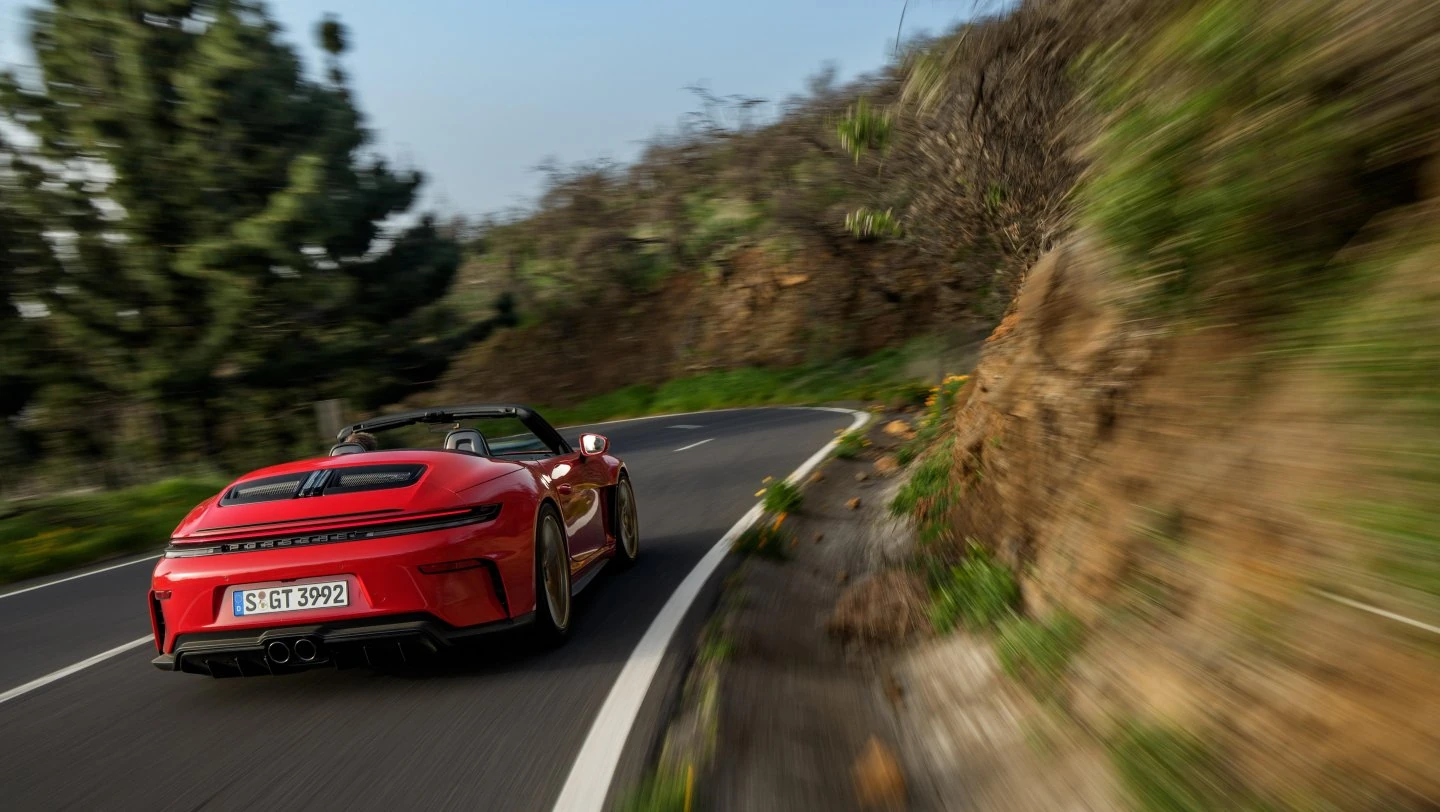
The 911, the model most inseparable from Porsche’s identity, increased global deliveries 19% in the first half of 2026, reaching 30,534 cars.
Porsche’s first-half operating profit also rose to €1.35 billion, from €1.01 billion a year earlier, while operating return on sales improved to 7.8% from 5.5%.
There is an important wrinkle inside that improvement. Porsche said net burdens from strategic realignment were about €100 million in H1 2026, compared with roughly €800 million in the prior-year period. Cost management, pricing and product mix also helped.
So the higher first-half operating profit is useful counterevidence, but it does not erase the weaker volume, China pressure or the later change in Volkswagen’s medium- and long-term assumptions.
And those first-half figures predate Volkswagen’s September impairment decision.
The better reading is that Porsche is dealing with several things at once: lower overall volume, a much weaker China market, product transitions, tariffs and the cost of reshaping strategy, while some of its most identity-defining products remain highly desirable.
Porsche calls its approach “value over volume.”
The 911 makes the phrase easier to understand. A company can sell fewer vehicles overall while demand for the product that most clearly carries the brand’s mythology moves in the other direction.
That is exactly the sort of tension a brand-valuation model and an accounting impairment test can interpret differently.
This Is the Luxury Paradox, Not Just a Porsche Paradox
Luxury companies spend decades building value that does not live neatly inside factories, inventory or quarterly unit volume.
It lives in the willingness to pay more for a name, a shape, a history, a signal, a feeling.
That economic residue matters. It can help preserve consideration and cultural relevance when operating conditions get harder.
But brand equity is not armor.
A powerful name cannot fix a weak region. It cannot remove tariffs, solve a product gap, reverse a mistimed technology bet or guarantee that yesterday’s profit assumptions still make sense tomorrow.
What it can do is give the company something unusually valuable to protect while those problems are being solved.
That is why Porsche’s giant numbers are more revealing together than separately.
Brand Finance’s $35.2 billion estimate says the Porsche name still has exceptional economic pull within its model.
Volkswagen’s €13.8 billion brand-name carrying value and €16.2 billion goodwill carrying value show that its own accounts also distinguish the name from the broader goodwill attached to the business.
And Volkswagen’s approximately €6 billion 2026 goodwill impairment, after a €2.7 billion goodwill impairment in 2025, says expectations for the business have been revised enough to force another accounting reset.
One measure is trying to value the magnet.
The other is testing the machinery around it.
The Brand Is an Asset. It Is Not an Alibi.
The harder question for Porsche is whether the company can translate the desirability that Brand Finance still sees into stronger economics under a different set of market conditions.
That means the useful 2026 Porsche story is neither “the brand is fine” nor “the business is broken.”
It is that one of luxury’s strongest names is entering a period in which the value of the brand may be one of the company’s most important assets precisely because the operating environment around it has become harder.
And that makes the distinction between brand value and business value more important, not less.
Cover Image: Porsche 911 GT3 S/C, 2026. Photo: Porsche AG. Source